


Freischütz Digital Multitrack Dataset




Funding Code 01UG1239A to C
Introduction
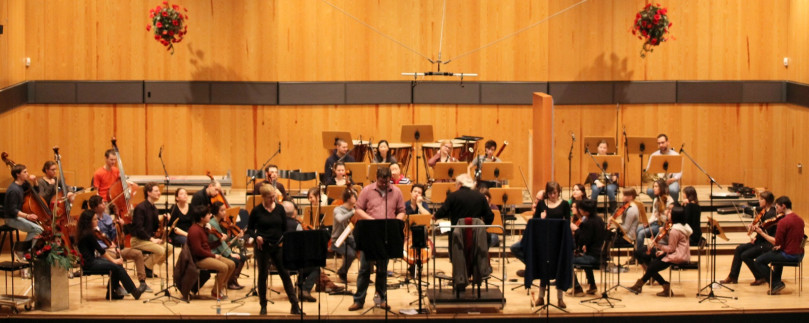
In the project Freischütz Digital, three numbers (No. 06, 08, 09) of the opera "Der Freischütz" from Carl Maria von Weber have been recorded by the Erich-Thienhaus-Institute (HfM Detmold). The recording was carried out by the Tonmeister students Stefan Antonin (No. 6), Florian Bitzer (No. 8), and Matthias Kieslich (No. 9) under the supervision of Prof. Dipl-Tonm. Bernhard Güttler, and Prof. Dipl-Tonm. Michael Sandner. Further information on the recording sessions and audio production can be found on the Freischütz Digital website:
- Background informations on the recording session (in german)
- Finalization of the audio production (in german)
This website provides the outcome of this recording project. For each of the recorded numbers (No. 6, 8, 9), we provide:
- The final stereo mixes
- The mono bounces without processing as well as with EQ and delays
- Group and Instrument Submixes (STEMS)
- Automation Tracks
All WAV files are sampled at 48 kHz/24 bit. Note that we provide mp3 previews of the files. The raw data can be obtained from Zenodo.
Microphone setup: The following image shows the setup of the 25 microphones used in the recordings, involving two main microphones for recording a stereo image and at least one spot microphone for each instrument section. For each string section, a spot microphone at the front (Nf) and at the rear (Nr) position was used. Additionally, clip microphones (C) were used for principal musicians of the string sections.
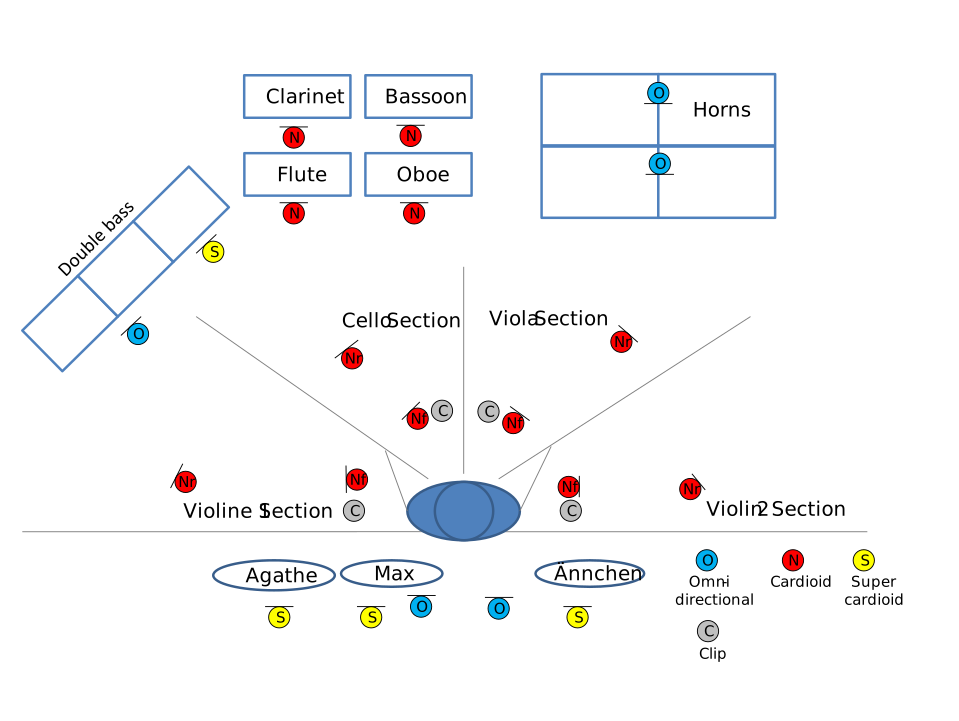
The first violin section, for example, was recorded with three microphones: one at the front position, one at the rear position, and a clip microphone attached to the principal musician's instrument. Usually, a voice is captured by its spot microphones before it arrives at the main microphones which are positioned further away. Therefore, it is important to compensate for different runtimes by delaying the spot microphones such that their signals are synchronized to the main microphones. This avoids unwanted reverberation or artifacts (caused by phase interference) in the mixing process. Furthermore, individual equalizers are applied to each of the microphones to suppress frequencies that are outside of the range of their associated voice. Note that in a typical professional setup, the recording room is equipped with sound absorbing materials and acoustic shields to isolate all the voices as much as possible. However, especially for orchestra music, complete acoustic isolation between the voices is often not possible. In practice, each microphone not only records sound from its dedicated voice, but also from all others in the room. This results in recordings that do not feature isolated signals, but rather mixtures of a predominant voice with all others being audible through what is referred to as interference, bleeding, crosstalk, or leakage. The recordings presented on this website all have interference between the different microphones.
Literature
If you publish results obtained using this dataset, please cite [1]. Further details on the dataset are discussed in [2,3].
- Thomas Prätzlich, Meinard Müller, Benjamin W. Bohl, and Joachim Veit
Freischütz Digital: Demos of audio-related contributions
In Demos and Late Breaking News of the International Society for Music Information Retrieval Conference (ISMIR), 2015. PDF@inproceedings{PraetzlichMBV15_FreiDi_ISMIR-LBD], author = {Thomas Pr{\"a}tzlich and Meinard M{\"u}ller and Benjamin W. Bohl and Joachim Veit}, title = {{F}reisch{\"u}tz {D}igital: Demos of audio-related contributions}, booktitle = {Demos and Late Breaking News of the International Society for Music Information Retrieval Conference ({ISMIR})}, address = {M{\'a}laga, Spain}, year = {2015}, url-pdf = {2015_PraetzlichMBV_FreiDi_ISMIR-LBD.pdf} } - Thomas Prätzlich
Freischütz Digital: Processing Audio Signals in Complex Music Scenarios
PhD Thesis, Friedrich-Alexander-Universität Erlangen-Nürnberg (FAU), 2016. PDF@phdthesis{Praetzlich16_FreiDi_PhD, author = {Thomas Pr{\"a}tzlich}, title = {Freisch{\"u}tz Digital: Processing Audio Signals in Complex Music Scenarios}, type = {doctoralthesis}, school = {Friedrich-Alexander-Universit{\"a}t Erlangen-N{\"u}rnberg (FAU)}, year = {2016}, url-pdf = {2016_Praetzlich_Thesis_PhD.pdf} } - Meinard Müller, Thomas Prätzlich, and Christian Dittmar
Freischütz Digital — When Computer Science Meets Musicology
In Festschrift für Joachim Veit zum 60. Geburtstag: 551–573, 2016. PDF Details@inproceedings{MuellerPD16_FreischuetzDigital_Veit, author = {Meinard M{\"u}ller and Thomas Pr{\"a}tzlich and Christian Dittmar}, title = {{F}reisch{\"u}tz {D}igital -- {W}hen Computer Science Meets Musicology}, booktitle = {{F}estschrift f{\"u}r Joachim Veit zum 60. Geburtstag}, editor = {Kristina Richts and Peter Stadler}, publisher = {{A}llitera}, address = {M{\"u}nchen, Germany}, year = {2016}, pages = {551--573}, url-pdf = {2016_MuellerPD_FreischuetzDigital_VeitFestschrift.pdf}, url-details = {http://www.freischuetz-digital.de/} }
Downloads
The full dataset is available via the corresponding Zenodo link as uncompressed WAV files (48 kHz, 24 bit).
doi.org/10.5281/zenodo.20285754
For research purposes, please use the original WAV files from Zenodo rather than the MP3 preview files provided on this website.
Stereo Mixes
An artistic stereo mixture including all voices and microphones was produced. This is the kind of mixture one usually finds on professionally produced CD recordings.
| No | Filename | |
|---|---|---|
| 06 | Weber_Freischuetz-06_Bloemeke2013.mp3 | |
| 08 | Weber_Freischuetz-08_Bloemeke2013.mp3 | |
| 09 | Weber_Freischuetz-09_Bloemeke2013.mp3 |
Mono Bounces - RAW
Here you find the mono bounces (raw recordings). These are the signals as they were recorded by the microphones without further processing. Entries in the table marked with a dash '-' specify that an instrument/voice is not present in the number. If the microphone string (Mic String) is followed by a dash, then the first character specifies the type of microphone (N: cardioid, S:super-cardioid, O: omnidirectional, C: clip microphone). An optional second character specifies the microphone position (f: front, r: rear). All tracks have been recorded with cardioid microphones (N) except:
- Microphone 23-25 (Singers): super-cardioid (S)
- Microphone 15 (Bass): omnidirectional (O)
- Microphone 05,08,11,14 (Strings): clip microphone (C)
| Mic No. | Mic String | Description | No. 6 | No. 8 | No. 9 |
|---|---|---|---|---|---|
| 01 | aa-O | Main microphone 1 | mp3 | mp3 | mp3 |
| 02 | bb-O | Main microphone 2 | mp3 | mp3 | mp3 |
| 03 | vn1-Nf | Violin 1 (front) | mp3 | mp3 | mp3 |
| 04 | vn1-Nr | Violin 1 (rear) | mp3 | mp3 | mp3 |
| 05 | vn1-C | Violin 1 (clip) | mp3 | mp3 | mp3 |
| 06 | vc-Nf | Cello (front) | mp3 | mp3 | mp3 |
| 07 | vc-Nr | Cello (rear) | mp3 | mp3 | mp3 |
| 08 | vc-C | Cello (clip) | mp3 | mp3 | mp3 |
| 09 | va-Nf | Viola (front) | mp3 | mp3 | mp3 |
| 10 | va-Nr | Viola (rear) | mp3 | mp3 | mp3 |
| 11 | va-C | Viola (clip) | mp3 | mp3 | mp3 |
| 12 | vn2-Nf | Violin 2 (front) | mp3 | mp3 | mp3 |
| 13 | vn2-Nr | Violin 2 (rear) | mp3 | mp3 | mp3 |
| 14 | vn2-C | Violin 2 (clip) | mp3 | mp3 | mp3 |
| 15 | db-O | Bass (omni) | mp3 | mp3 | mp3 |
| 16 | db-S | Bass | mp3 | mp3 | mp3 |
| 17 | fl-N | Flute | mp3 | mp3 | mp3 |
| 18 | ob-N | Oboe | - | mp3 | - |
| 19 | cl-N | Clarinet | mp3 | mp3 | mp3 |
| 20 | bn-N | Bassoon | mp3 | mp3 | mp3 |
| 21 | hn-Nf | Horn (front) | mp3 | mp3 | mp3 |
| 22 | hn-Nr | Horn (rear) | mp3 | mp3 | mp3 |
| 23 | s1-S | Singer 1 (Ännchen) | mp3 | - | mp3 |
| 24 | s2-S | Singer 2 (Max) | - | - | mp3 |
| 25 | s3-S | Singer 3 (Agathe) | mp3 | mp3 | mp3 |
Mono Bounces - EQDEL
Here you find the delayed and equalized mono bounces. The raw mono bounces were delayed with respect to the main microphones (AA,BB). Futhermore, individual equalizers (EQs) have been applied to the signals. These tracks have been used in the final mixing process. Entries in the table marked with a dash '-' specify that an instrument/voice is not present in the number.
| Mic No. | Mic String | Description | Delay | No. 6 | No. 8 | No. 9 |
|---|---|---|---|---|---|---|
| 01 | aa-O | Main microphone 1 | 0 | mp3 | mp3 | mp3 |
| 02 | bb-O | Main microphone 2 | 0 | mp3 | mp3 | mp3 |
| 03 | vn1-Nf | Violin 1 (front) | 268 | mp3 | mp3 | mp3 |
| 04 | vn1-Nr | Violin 1 (rear) | 473 | mp3 | mp3 | mp3 |
| 05 | vn1-C | Violin 1 (clip) | 0 | mp3 | mp3 | mp3 |
| 06 | vc-Nf | Cello (front) | 403 | mp3 | mp3 | mp3 |
| 07 | vc-Nr | Cello (rear) | 552 | mp3 | mp3 | mp3 |
| 08 | vc-C | Cello (clip) | 0 | mp3 | mp3 | mp3 |
| 09 | va-Nf | Viola (front) | 342 | mp3 | mp3 | mp3 |
| 10 | va-Nr | Viola (rear) | 601 | mp3 | mp3 | mp3 |
| 11 | va-C | Viola (clip) | 0 | mp3 | mp3 | mp3 |
| 12 | vn2-Nf | Violin 2 (front) | 329 | mp3 | mp3 | mp3 |
| 13 | vn2-Nr | Violin 2 (rear) | 601 | mp3 | mp3 | mp3 |
| 14 | vn2-C | Violin 2 (clip) | 0 | mp3 | mp3 | mp3 |
| 15 | db-O | Bass (omni) | 832 | mp3 | mp3 | mp3 |
| 16 | db-S | Bass | 861 | mp3 | mp3 | mp3 |
| 17 | fl-N | Flute | 648 | mp3 | mp3 | mp3 |
| 18 | ob-N | Oboe | 659 | - | mp3 | - |
| 19 | cl-N | Clarinet | 790 | mp3 | mp3 | mp3 |
| 20 | bn-N | Bassoon | 825 | mp3 | mp3 | mp3 |
| 21 | hn-Nf | Horn (front) | 922 | mp3 | mp3 | mp3 |
| 22 | hn-Nr | Horn (rear) | 953 | mp3 | mp3 | mp3 |
| 23 | s1-S | Singer 1 (Ännchen) | 160 | mp3 | - | mp3 |
| 24 | s2-S | Singer 2 (Max) | 160 | - | - | mp3 |
| 25 | s3-S | Singer 3 (Agathe) | 160 | mp3 | mp3 | mp3 |
Stereo Instrument Mixes
For demonstration purposes, additional stereo mixtures were produced for each individual voice.
| Voice | Description | No. 6 | No. 8 | No. 9 |
|---|---|---|---|---|
| bn | Bassoon | mp3 | mp3 | mp3 |
| fl | Flute | mp3 | mp3 | mp3 |
| db | Bass | mp3 | mp3 | mp3 |
| cl | Clarinet | mp3 | mp3 | mp3 |
| ob | Oboe | - | mp3 | - |
| s1 | Solo1 | mp3 | - | mp3 |
| s2 | Solo2 | - | - | mp3 |
| s3 | Solo3 | mp3 | mp3 | mp3 |
| va | Viola | mp3 | mp3 | mp3 |
| vc | Cello | mp3 | mp3 | mp3 |
| vn1 | Violin 1 | mp3 | mp3 | mp3 |
| vn2 | Violin 2 | mp3 | mp3 | mp3 |
Stereo Group Mixes
Additional group mixes were produced including the woodwinds (bassoon, fute, clarinet, oboe), the strings (violin 1, violin 2, viola, cello, double bass), and the singers.
| Description | No. 6 | No. 8 | No. 9 |
|---|---|---|---|
| Main Microphones | mp3 | mp3 | mp3 |
| Horns | mp3 | mp3 | mp3 |
| Woodwinds (bn, fl, cl, ob) | - | mp3 | mp3 |
| Singers (s1, s2, s3) | mp3 | mp3 | mp3 |
| Strings (vn1,vn2,va,vc,db) | mp3 | mp3 | mp3 |
Automation Tracks
During the recordings, the volumes of the singing voice has been continuously adapted. To make this process clear, we provide the automation tracks for these tracks.
| Description | No. 6 | No. 8 | No. 9 |
|---|---|---|---|
| Solo1 automation track | mp3 | - | mp3 |
| Solo2 automation track | - | - | mp3 |
| Solo3 automation track | mp3 | mp3 | mp3 |
License

This work is licensed under a Creative Commons Attribution-NonCommercial-ShareAlike 4.0 International License.
Acknowledgements
This work has been supported by the BMBF project Freischütz Digital (Funding Code 01UG1239A to C). The International Audio Laboratories Erlangen (AudioLabs) is a joint institution of the Friedrich-Alexander-Universität Erlangen-Nürnberg (FAU) and Fraunhofer IIS.
We would especially like to thank three groups of people, without whom this project could not have been realised: The Tonmeisters, who formed a wonderful team:
- Prof. Dipl-Tonm. Bernhard Güttler
- Prof. Dipl-Tonm. Michael Sandner
- Stefan Antonin (No. 6)
- Florian Bitzer (No. 8)
- Matthias Kieslich (No. 9)
And so did the singers:
- Stefanie Krahnenfeld (Agathe)
- Kirsten Labonte (Ännchen)
- Tobias Haaks (Max)
As well as the orchestra conducted by Karl-Heinz Bloemeke.